Alan Greenberg: Education, AI and the Skills We Will Need for the Future
If AI can already write, analyze information and explain complex topics, what should universities be teaching us? And which skills will matter in a world where professions are changing faster than education systems can adapt?
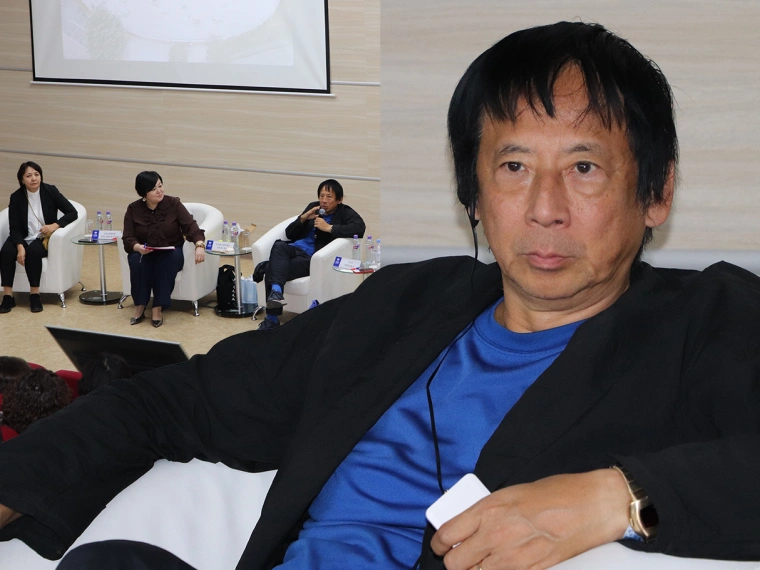
This autumn, inVision U welcomed its first undergraduate cohort, marking the launch of the university’s bachelor’s programme. Alan Greenberg came to Almaty as part of the event dedicated to this new chapter, and during his visit, STEPPE spoke with the former head of Apple Education and one of the people behind the development of iTunes U about how AI is reshaping education, why it should enhance rather than replace teachers, why the ability to ask the right questions is becoming increasingly important, how professions may evolve, and why technology alone means little without genuine expertise behind it.
«Teaching happens in the classroom. Learning happens 24/7»
— I was privileged and lucky enough to be invited to work at Apple by Pascal Cagni, who was the Chief Executive of Apple Europe at the time. He invited me to look at how Apple was doing business in education. Apple already had traditional salespeople going to universities and schools and talking about technology, but no one was really looking at the broader impact of digital technology on education.
So when I joined Apple, I started with research. Having an Apple business card meant I could get meetings with some very senior people. I spoke to university vice-chancellors, heads of IT departments and school leaders across the UK, France, Germany and other European countries. But I didn’t talk to them about Apple technology. I talked to them about the challenges they had.
What became apparent very quickly was that schools and universities wanted some form of digital engagement, but they didn’t really know what it should look like. It also became clear that content was key: textbooks, curriculum and subject matter. At the time, only a few universities were progressive in developing digital content. In the UK, the Open University was one of the first. In France, HEC Business School and the University of Lyon were among the institutions doing interesting work.
Working with our systems engineers, I began to see that turning educational content into digital files and distributing it more widely was a real opportunity. That work eventually contributed to the development of podcasting at Apple. At the beginning, there was no revenue attached to podcasting, so commercially it wasn’t particularly exciting. Nobody had any idea how large it could become. But our team continued to cultivate and develop it, and eventually it became something much bigger.
Apple was obviously a product company. It wanted schools and universities to use its computers and, later, products such as the iPod and iPad. But instead of simply relying on salespeople knocking on doors, we developed different ways of bringing technology into education. One example was the Apple Distinguished Educator Programme, which I contributed to. The idea was to put technology into the hands of educators themselves. Instead of a salesperson saying, «You should use this technology», you had a teacher using it in the staff room while other teachers looked over their shoulder and said, «Actually, this is really good. It’s intuitive, easy to use and powerful».
That influence worked in both directions. Teachers could influence the people responsible for budgets because they were saying, «We want this for teaching and learning.» At the same time, students were arriving at schools and universities expecting digital engagement. Programmes like Apple Distinguished Educator, podcasting and other digital initiatives became catalysts for Apple’s growth in education. Back in 2004, 2005 and 2006, Microsoft had major relationships with many schools and universities. Innovations like these helped Apple break through that barrier and become an increasingly important partner in the education ecosystem.
The simplest way to understand why these technologies mattered is to ask two questions: where does teaching happen, and where does learning happen? Teaching happens in 45-minute or one-hour slots, perhaps three or four times a week for a particular subject. But learning happens 24 hours a day, 365 days a year. It depends on how much a student wants to engage, how much they want to commit to learning and how much effort they are prepared to put in. If you can make educational resources available in that 24/7 environment, that’s where the magic happens.
Podcasting had a huge influence on changing that ecosystem because suddenly education wasn’t simply about taking a textbook home and doing a homework exercise. Knowledge became available outside the classroom.
That was followed by iTunes U, where universities could publish their content through Apple’s platform and distribute it globally. I was one of three senior managers who helped build the iTunes U project, and there were literally hundreds, if not thousands, of universities sharing their content through the platform.
iTunes U no longer exists, but sometimes when I speak at conferences, I meet people who are now in their early or mid-thirties and went to university during that period. When they find out that I helped build podcasting and develop iTunes U globally, they come up to me and say thank you because that content helped them get through their university degree. That’s very rewarding.
«AI should not replace the teacher. It should enhance the teacher»
— The whole principle of education has fundamentally changed with AI. Historically, education was top-down. A teacher would come into a classroom or a lecturer would enter a lecture hall, students would sit there quietly, take notes and hopefully learn something.
That ecosystem has now been turned 180 degrees. Today, learning and education are increasingly bottom-up because almost all the knowledge in the world is accessible through AI. Much of what a teacher previously articulated or shared is now available through large language models and generative AI.
But there is a problem. If you haven’t been taught critical thinking, these tools have much less value. Critical thinking is partly about being able to construct the right question. If you can’t construct the right question, you can’t get the full value from these tools.
Even more important is critical thought. That means not simply accepting the answer that comes back to you, but looking at it and deciding what is actually relevant to your thesis, question, theory or subject. Students — and adults as well — need to understand that these tools are only as good as the questions we ask and our ability to interpret the information that comes back.
I’m interested in what I would describe as the second generation of AI. The first generation is the big general-purpose LLMs. What interests me more is built-for-purpose AI. It should be mission-driven and focused on a specific subject or problem rather than trying to cover the entire internet.
The second element is authenticity. AI should be trained on content that is peer-reviewed, has academic rigour and is supported by credible research. In education, academics should decide what information needs to be searched and consolidated — whether that’s textbooks, lesson plans or other educational resources.
The third element is what I call the trust coefficient. Even if something is built for purpose and uses authentic content, can you actually trust it? This is particularly relevant to universities because universities have a reputation and a responsibility for bringing authentic content and credible information to students.
If you combine those elements — mission-driven AI, authentic content and trust — and then teach critical thinking and critical thought, you begin to have a solution for what education can look like in the AI era.
The final part is the personal learning journey. Imagine a teacher walking into a classroom with 30 students. Traditionally, the teacher has to teach somewhere around the middle. You might have 20 students around the average level, five who need more support and five who are ahead. The students who are struggling need help reaching the average, but there’s another problem: the five students at the top can effectively be held back when they should be accelerated.
That’s essentially what a classroom has looked like for hundreds of years. Now imagine being able to teach every single student according to their own level of competency in each subject. AI tutoring can make that possible.
It doesn’t replace the teacher. It enhances the teacher. It doesn’t take the teacher out of the classroom; it enhances the teacher’s performance within the classroom. I would describe that as a blended solution. The teacher remains responsible for the curriculum, courseware, subject matter and empowering individual students, while technology can provide each student with a personal learning journey and a personal learning outcome, both at school and at home.
This isn’t tomorrow’s technology. This is today’s technology.

One of my portfolio companies, ASI.Tech, successfully built an AI tutor for the UAE government. We trained it on authentic content, but we also built a competency level into the platform. Imagine you and I are studying the same subject — economics, for example — and we’re both asking questions about inflation. Your question might be more sophisticated and nuanced than mine. We’re both accessing the same database of knowledge, but the technology can recognize that you’re further along in your learning journey and provide an answer that reflects the sophistication of your question.
At the same time, it can recognize my level of competency and give me an answer appropriate to my level of knowledge. That doesn’t necessarily mean you’re more intelligent than I am. It simply means your learning journey may be smoother or more direct, while mine might take longer. I can still get to the same point, but my journey is different.
That’s what I mean by a personal learning journey and personal learning outcome. The technology recognizes the nuance of how you frame a question and makes information relevant to you. It’s not a one-size-fits-all scenario. It’s a relevance engine...
What should you study when nobody knows which jobs will exist?
— Everything I’ve been discussing is built around the principle of human in the loop. We’re not talking about AI replacing teachers, schools or universities. We’re talking about AI enhancing the traditional education process and supporting the ecosystem that already exists.
There are many tools dealing with tutoring, education and academic subjects. But very few deal with character and social-emotional learning — the skills people need in order to survive and succeed in society: grit, perseverance, resilience and mastery. Those are also things education needs to teach.
Today, you’re unlikely to have one job for your entire life. People may have multiple careers and constantly adapt to new circumstances. That means the skills and strength of character required to navigate change need to become part of education as well.
There’s also a broader question about the value of a degree. Historically, getting a good degree from a good university could almost guarantee you a job. Today, perhaps not so much. I’m not saying you don’t need a degree. But imagine having a degree alongside evidence that you are hardworking, talented, persistent, resilient and capable of taking on challenges. When an employer understands the character and personality of an individual as well as their academic qualifications, that can be incredibly powerful.
But there’s another element that technology can’t create for you: motivation.
When I came to inVision U and met the young people in this cohort, I found them extraordinary. They’re passionate, they’re keen to learn, they have a voice and they ask questions. When I come to Central Asia, or visit countries such as China and India, I often see young people who are hungry to learn and motivated to improve their circumstances. They want to get a job, build a career, invent technology or create something new.
You cannot replace that passion.
Without passion, an inquisitive mind and genuine interest, technology can only take you so far. The particular subject is almost incidental — that inquisitive mind is key. I also believe families have a responsibility here. Schools have responsibilities, but parents also need to motivate young people, and students themselves need to be ambitious and aspirational and want to become the best version of themselves.
They don’t necessarily have to become the most successful person. They simply need to become the best version of themselves.
And when we talk about professions of the future, I think we have to remember that if you look at history, things have always changed. The Industrial Revolution changed work. Agriculture changed when tractors were invented. Everything evolves, but we adapt. We change, iterate and develop new things.
Nobody knows exactly what the future looks like. Nobody. But I do think jobs will change.
Would I rush to become a traditional management consultant today? Probably not. I can use tools like Claude to do in a couple of hours some of the analysis that previously could have taken a consultancy months and cost an enormous amount of money.
But that doesn’t necessarily mean management consultants disappear. They evolve. Consulting companies are already becoming technology advisers and technology developers for their clients. So the question becomes: are they still traditional management consultancies, or are they becoming something different?
Medicine is another interesting example. Arizona State University is developing a new medical school around the convergence of medicine and AI. The idea isn’t simply to train excellent doctors; it’s to train doctors who are AI-native and comfortable working with AI.
If that’s happening in medicine, why shouldn’t it happen in engineering? Why shouldn’t it happen in architecture or any other field?
So I don’t think parents should necessarily be afraid. I would tell them to focus on the things we’ve already discussed: critical thinking and critical thought. Teach young people how to ask the right questions and how to interpret the answers they receive rather than simply trusting an answer because ChatGPT produced it.
«If the content is not valuable, you probably shouldn’t start the project»
— There are billion-dollar businesses in education that are already becoming obsolete. They know they’re becoming obsolete, but they don’t necessarily want to admit it. They’re trying to pivot and become contemporary education companies using AI, but they’re often working from legacy structures that make genuine innovation difficult.
What interests me is something I would describe as services as software, rather than simply software as a service. These are systems that are more intuitive, more focused and designed around a particular expertise or problem.
One example is a project I’m working on with a leading specialist in women’s health, menopause and hormones. She has written books, produced hundreds of podcasts and YouTube videos, published research and has a clinic that has worked with tens of thousands of women. She is a genuine subject-matter expert.
We’ve taken the content she’s willing to share, placed it in a private environment and trained AI on that knowledge. The result is a built-for-purpose AI where women can access trusted, authentic information based on genuine specialist expertise.
Another company I work with is IndexLaw. It’s an AI legal platform focused not necessarily on providing services to lawyers, but on providing services directly to individuals, startups, entrepreneurs and enterprise organizations.
We’ve mapped law across multiple countries and regions, and users can interrogate that knowledge base. You can describe a legal challenge and receive information that helps you understand potential courses of action. It might be litigation, but it could also be compromise, arbitration or another solution.
It’s a blended model because we also have access, through partnerships, to thousands of lawyers globally. Once we understand the problem and jurisdiction, we can help match someone with a lawyer who has the appropriate expertise. The aim is to reduce time, reduce cost and make the process more efficient.
We’ve also developed the concept of a secure «vault» for confidential information. In a legal context, that could be intellectual property or sensitive company information. AI can interrogate information inside the vault without compromising the underlying confidential data.
The same principle could be applied to health. Imagine having your health data in a secure environment where a doctor can use AI to interrogate that information and support diagnostics or understand your health journey. Again, that’s a blended solution: not AI alone, but AI working alongside a human professional in a dedicated, trustworthy and compliant environment.
This is also why I think content and technology have to be understood as two different areas. You have content experts who understand curriculum, educational resources or their particular subject matter. Then you have technologists — and I would put myself in that box — who have the tools, competency and experience to help deliver that content. One person doesn’t necessarily need to be a specialist in both.
I’m currently developing a project with a company working on cutting-edge electric and hydrogen engineering in motorsport. They have extraordinary engineering knowledge. My question to them was: why don’t we turn that knowledge into an education programme? Why not take the engineering behind these technologies and bring it into schools, colleges, universities and engineering programmes?
Then you have rich, authentic content coming together with competent technology.
When I meet a potential partner with deep subject knowledge, I sometimes ask a very uncomfortable question: «On a scale of one to ten, how good are you?»
It sounds like a horrible question, perhaps even like a trick question, but it isn’t. I need to understand whether someone genuinely knows their subject. If they’re as good as I think they are, then it becomes exciting because technology can help amplify that expertise.
But if they’re not, I need to know before we spend time, money and resources building something around content that isn’t strong enough. You can have excellent technology, but if the underlying content isn’t credible or valuable, the project won’t fulfil its potential.
Technology is ultimately the delivery process. It’s how you get knowledge and resources into the hands of the learner. If the content is not valuable, you probably shouldn’t start the project.
There is also a financial challenge. Historically, technology development has depended heavily on venture capital. Money has often dictated what technology can and cannot be developed. Today, getting investment for early-stage companies in education, health and deep tech is particularly challenging because so much money is chasing LLMs and data centres.
When that happens, you need different ways of building projects. A lot of my work today is based on joint ventures. You might have one person who has the resources and vision to invest in changing society. Then you have someone with deep subject expertise and the ability to build the product or institution. And then you bring in technology that can complement both.
When those three things converge and people work collaboratively, that’s where the magic happens.
And despite all the concerns around AI, I’m an optimist. You can’t predict ten years into the future. You can barely predict ten days into the future. I’m not saying concerns about AI are nonsense — it would be foolish to say that. But I believe human beings will continue to play a critical role.
If you’re a bad actor, you can build bad AI. If you’re a good actor, you can build good AI. I choose to focus on building dedicated, focused and authentic AI that can improve people’s education and training, help medical professionals, nurses and hospitals, and create opportunities for lifelong learning and professional development. Those are the opportunities I see in front of us.
«The opportunity for Kazakhstan is extraordinary»
My knowledge of Kazakhstan is limited to three and a half days, so I don’t want to pretend that I understand the entire country. But I’ve spent time with some really interesting people, and what I’ve seen has been remarkable.
At inVision U, I’ve met young people who are talented, ambitious, aspirational, passionate about learning and committed to becoming the best versions of themselves. Of course, one institution cannot represent an entire country. But if what I’ve seen is indicative of the generation coming through in Kazakhstan, the opportunity for this country is extraordinary.
What is particularly interesting is having a young population with people who want to learn, improve themselves, develop careers and fulfil their potential. I believe collaboration is going to be important in unlocking that potential — bringing together educators, technology, investment and people who genuinely want to build something.
What I’ve also noticed here is that there are successful people who want to give something back to society. You have people investing in education, culture and institutions that can contribute to the next generation. That doesn’t happen everywhere.
When successful people decide they want to give back, and when that investment is connected to people with strong ideas and the ability to execute them, you can create something very powerful. Giving back can be incredibly fulfilling, and I’ve seen the impact of that personally throughout my career.
One of the projects I’m most proud of came when I was working for Apple in China. Steve Jobs and Terry Gou of Foxconn wanted to create a corporate social responsibility project to educate factory workers. That project came to me and one of my colleagues.
Foxconn allocated seven classrooms in Shenzhen, Apple provided 500 iMacs, and I eventually persuaded Pearson to provide educational content. The project was called SEED. In the first cohort, we had 4,967 students. These were young people who had worked 10- to 12-hour shifts on factory floors and then came to education classes to study engineering. Attendance was regularly between 92% and 96%, and in the first cohort alone, 196 students went on to Chinese universities.
Whenever I visited Foxconn, my Chinese colleagues would sometimes ask me to go into the classrooms and talk to the students. Many of them didn’t speak English, so I would simply tell stories. One day, after a few minutes, several students got out of their seats, came over, sat near me and started touching my arm and leg. I had no idea what was happening.
Later, my colleagues explained it to me. The students knew who I represented and knew that I was there to help them, but they almost couldn’t believe I was real. Touching me made the experience real to them.
That experience helped me understand what giving back actually means. It wasn’t about money. It was about seeing what an opportunity could mean to a young person.
Later, when other executives from Apple and Pearson visited the project, I insisted that they go into those classrooms too. I remember one Pearson director sitting with the students and experiencing exactly the same thing. The students came closer and listened to her stories, and eventually she had tears running down her face. I remember looking at her and thinking: that’s what giving back looks like.
When you’ve been successful and have the opportunity to contribute to the next generation, that can be worth far more than money. That experience has influenced everything I’ve done since leaving Apple.
I’m obviously very proud of my work at Apple. I was there at an incredibly creative time, and being involved in podcasting and iTunes U was an extraordinary opportunity. I’m also incredibly proud of the Foxconn education project, even though it’s probably something most people will never hear about.
Today, I’m fortunate to work with extraordinarily talented young people and build new companies with them. One of the companies I’m particularly proud of is IndexLaw, which is currently part of Y Combinator and is beginning to work with major organizations in the UAE.
And when I look at the young people I’ve met here in Kazakhstan, I see some of those same characteristics: ambition, curiosity, a desire to learn and an appreciation that people are willing to share their experience with them.