Bvlgari and Monia Ben Hamouda's ongoing dialogue reaches the Venice Biennale
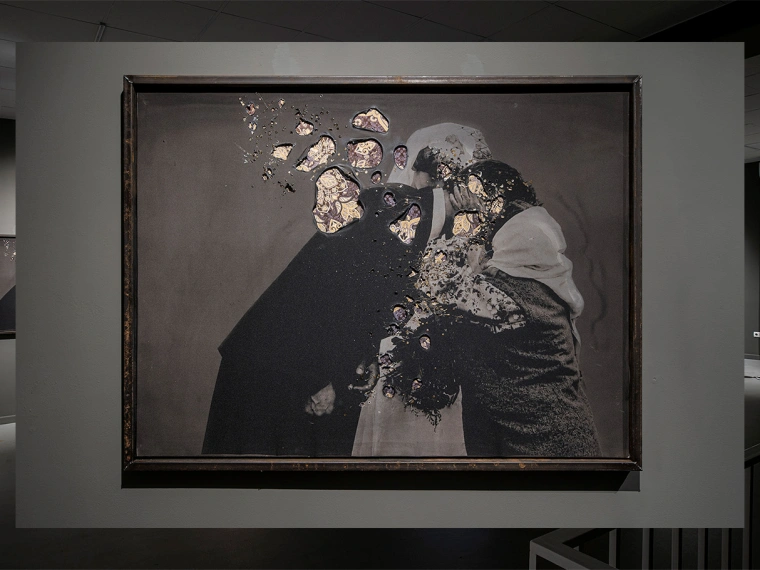
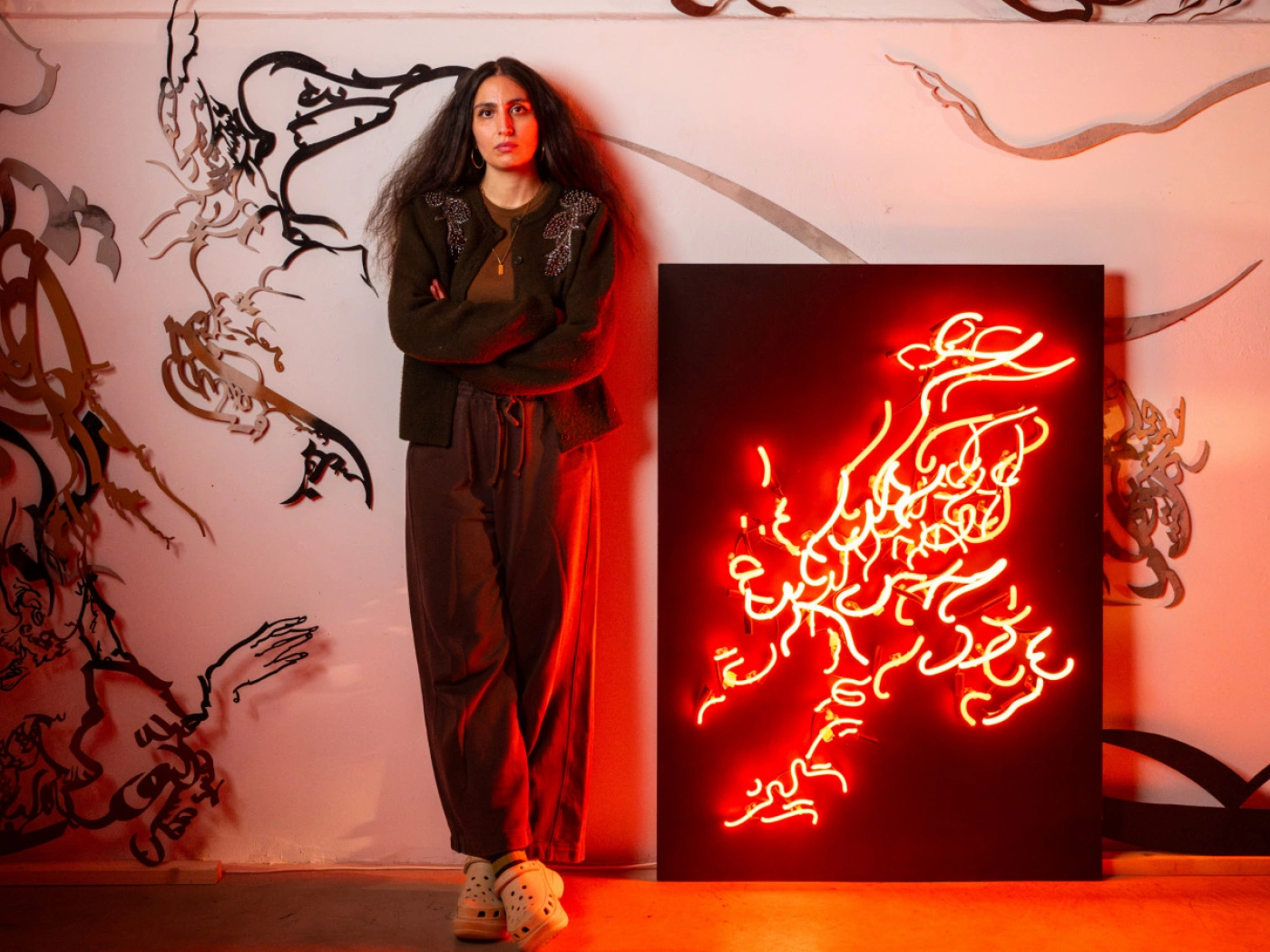
Tunisian-Italian artist Monia Ben Hamouda works between Milan and al-Qayrawan. Winner of the MAXXI Bvlgari Prize and former fellow at the American Academy in Rome, she creates sculptures, installations, and site-specific works that treat writing as gesture rather than communication.
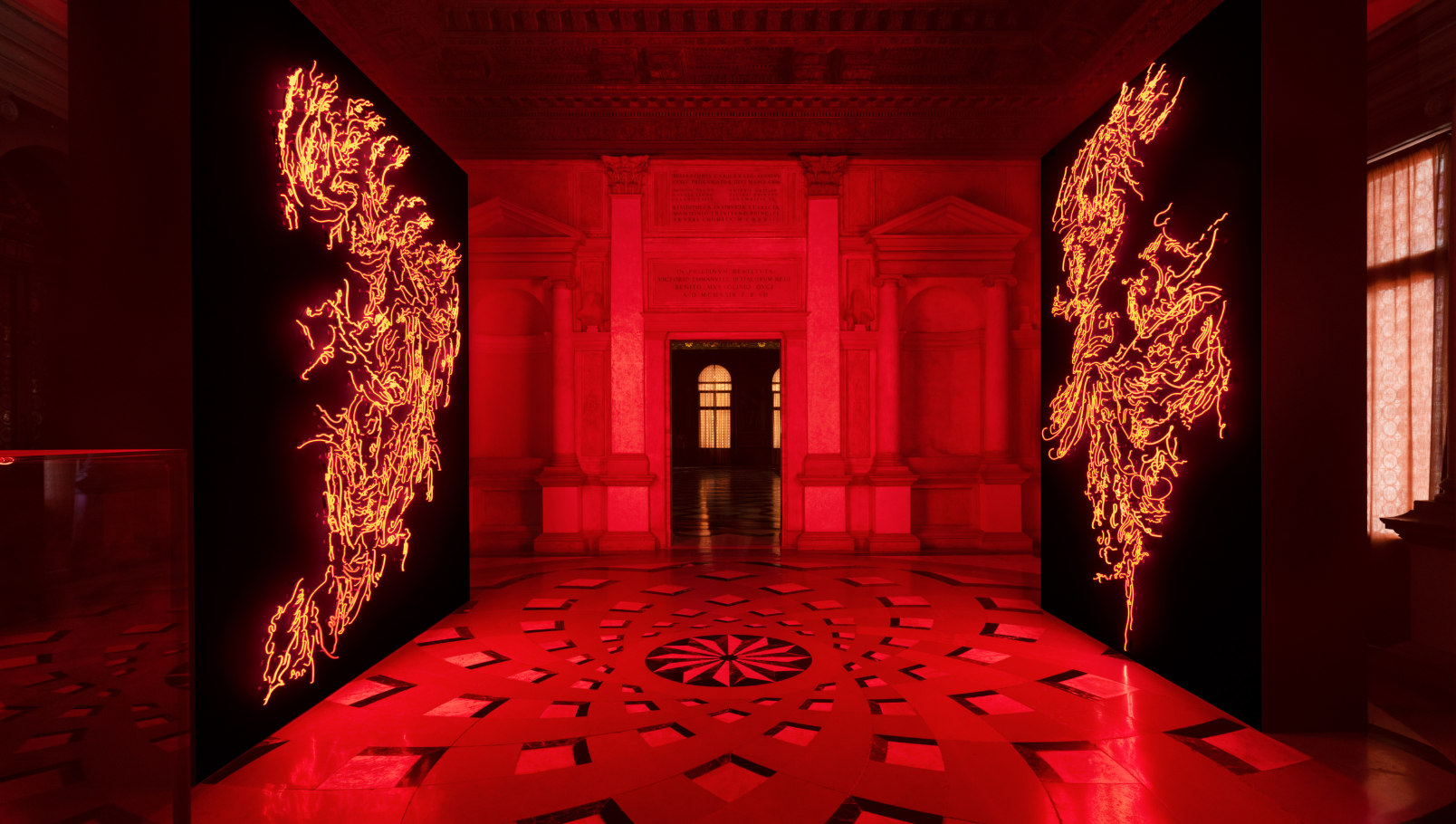
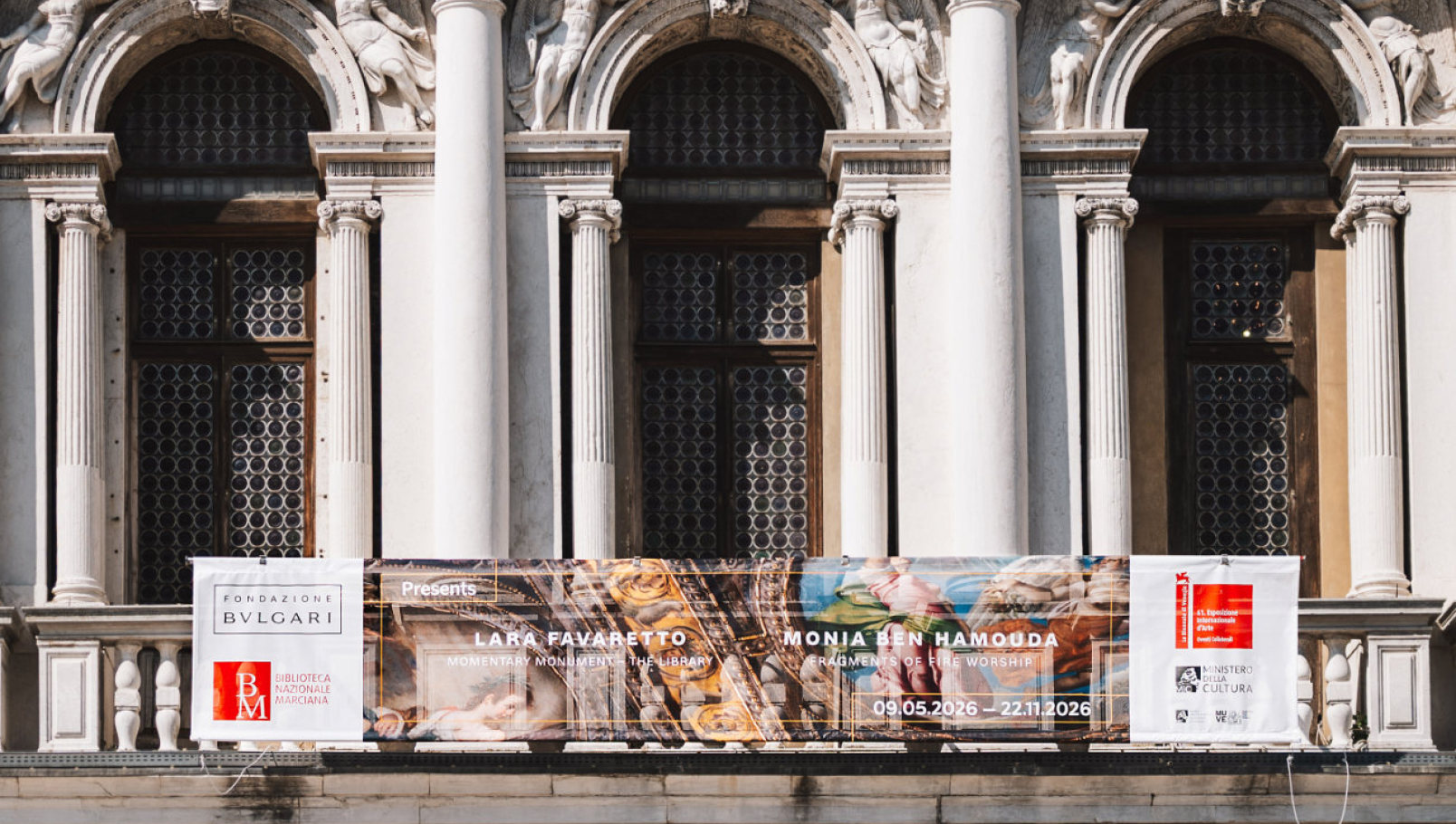
At the 2026 Venice Biennale, Fondazione Bvlgari commissioned her neon installation Fragments of Fire Worship for the vestibule of Biblioteca Nazionale Marciana — one of the oldest libraries in the world. In the interview for Steppe, we spoke with her about inherited scripts, the decision to make language unreadable, and what fire means in the context of knowledge and its destruction.
— Fragments of Fire Worship is installed in one of the oldest libraries in the world, a space built around the idea that knowledge is a living, transforming organism. How did that history inform what you made for it?
The context was the first, strong element of pressure. Rather than adapting to the space, I try to shift its logic from within, introducing elements that interrupt its apparent stability. Entering the vestibule of the Biblioteca Nazionale Marciana meant confronting a form of knowledge that presents itself as solid, ordered, almost untouchable. Rather than establishing a direct dialogue, I felt the need to work through friction, avoiding any illustrative or mimetic gesture. My intervention was guided by the idea of not occupying the space, but activating it laterally, introducing a presence that does not compete with the monumentality of the architecture, but subtly disturbs it.
I conceived the work as a controlled contradiction within an institution built on the promise of permanence, emerging from a tension between what remains and what can no longer be reconstructed as a system.
A library is a technology of preservation, and the Marciana represents an extreme condition of this: not only a place where knowledge is stored, but an architectural statement of knowledge as a monument.
— The vestibule of the Marciana is the first space a visitor enters before reaching the books and the collection. Did that threshold quality matter to you when you were developing the work?
The vestibule mattered precisely because it is a threshold: not yet the library, but already inside its architecture of knowledge.
I was interested in that suspended condition, before access, before the archive, before knowledge becomes fixed or fully available. The work inhabits this interval. It does not occupy the space as a destination, but as a moment of passage, where meaning remains unstable and cannot yet be possessed. I was also struck by the fact that the vestibule had been partially emptied of the sculptures that once occupied it, before they were moved to the Archaeological Museum. That absence became important to me. The space already carried a history of displacement: bodies removed, knowledge reorganized, authority redistributed elsewhere. In that sense, the threshold was not only an architectural condition, but also a place marked by subtraction.
The work enters this emptied space through light and suspended writing, without trying to fill what is missing. It stays within that tension between presence and removal, access and withholding, preservation and loss.
— Neon is a material we usually associate with clarity and instant readability. You use it to create forms that look like writing but resist being read. How did you arrive at that?
I choose materials for their capacity to store time and contradiction. These include spaces and architectures, history of art and the art system.
For several years now, my work has engaged with language and with the structural impossibility of full understanding: how meaning is never entirely shared, how it slips, fragments, or remains partially inaccessible. Fragments of Fire Worship extends this inquiry precisely within a space historically dedicated to the stabilization of knowledge. But the language we inhabit today is already compromised: meanings are continuously negotiated, redirected, instrumentalized, or emptied out while still maintaining the appearance of stability.
The neon medium allowed these contradictions to coexist. It behaves like a suspended fire. It speaks the language of urban visibility (signage, commerce, infrastructure) while simultaneously evoking ritual illumination and exposure. Bringing that material into the Marciana aims to produce a friction between different regimes of light, authority, visibility and violence.
I think of language less as a transparent system of communication than as a material constantly shaped by pressure, repetition, ideology, and time. Words accumulate history. They erode, fracture, sediment, and shift meaning depending on context and use. In my work, writing often moves toward that threshold where it stops functioning only as text and begins behaving more like architecture, trace, or residue. I am interested in the moment language loses stability and becomes matter again: something dense, vulnerable, and exposed to transformation. This is also why fragmentation matters to me: meaning never arrives intact, and every act of transmission already contains distortion, omission, reinterpretation.
Perhaps this also comes from growing up around calligraphy, where writing was never only semantic. Before transmitting meaning, language already existed as gesture, rhythm, proportion, bodily discipline. It occupied space physically. It was formed through memory and repetition, almost the way one paints a landscape from recollection: a tree, a cloud, the trace of something once seen and imperfectly retained. What interests me is that unstable space where language oscillates between presence and disappearance, between communication and opacity. A word can function simultaneously as image, structure, wound, monument, or debris.
The Biblioteca Nazionale Marciana (and, in another way, the Biennale itself) operates through systems of classification, interpretation, and display. Both are spaces where cultural meaning is organized and legitimized. Introducing a script that appears legible yet resists reading is an attempt to interrupt that logic from within. When a piece resembles writing but refuses to be read, the viewer’s attention shifts from comprehension to resonance: density, spatial pressure, duration, smell, the room’s temperature. That shift matters to me because it breaks the hierarchy in which language is assumed to be the highest form of knowledge.
— Fire in Arab and Islamic history carries many meanings at once: revelation, censorship, revolution, forgetting. How do you work with a symbol that holds all of that at the same time?
Symbolism is, again, a sculptural material for me. Fire, historically, has always been tied to tensions: it has been used to erase knowledge, but also to signal rupture, revolt, and transformation. Bringing this latent logic into a library is therefore not simply symbolic; it activates a historical memory of how fragile systems of knowledge actually are.
Fire has historically occupied a paradoxical place in relation to knowledge. It is the force that destroys archives and libraries, but also the force that reveals, illuminates, and makes knowledge visible. In Islamic visual traditions, for example, fire appears as a luminous halo surrounding prophetic figures.
Fragmentation and opacity in my work attempt to hold space for these contradictions without collapsing them into a single narrative. The work does not represent events directly; instead it constructs a condition where the viewer becomes aware of how knowledge, power, and vulnerability intersect.
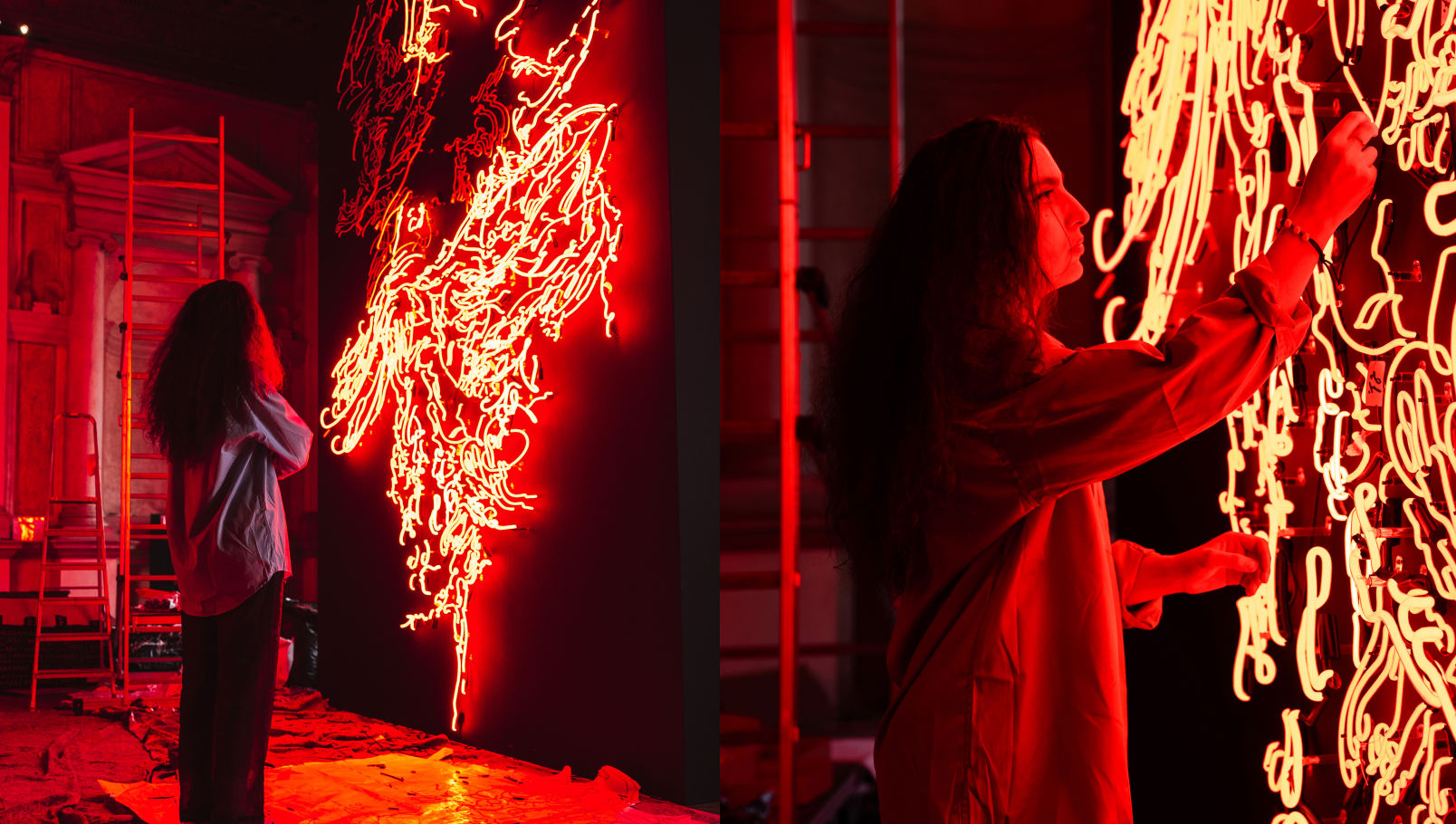
— Your practice has always moved across different materials and forms. How did you find your way to the specific language that defines your work today?
What defines my language is not a fixed visual style, but a way of organizing instability. Material selection begins with conceptual necessity, but it is finalized through sensory and behavioral response. I am not interested in the relationship between material and meaning in the sense of illustrating something that exists outside the experience of the work. I do not begin from a predefined meaning. Instead, I choose materials for their capacity to store time and to carry symbols that can be reactivated, often holding strong internal contradictions.
What interests me is how matter becomes charged, how it moves from substance to symbol, and how that transformation is never stable or resolved. Materials speak to me when they absorb this instability: surfaces hold residues, forms appear interrupted, elements are suspended or displaced. The object becomes less a representation of memory and more a site where memory is enacted. And absence, latency and persistence coexist materially. In my practice, the artwork is conceived not only as a visual phenomenon, but as a physical one. Through the use of smell, light, temperature, or spatial pressure, it enters the body, alters perception, and can generate reactions that are difficult to suppress.
I wish the experience to be very intense, and prolonged, and therefore to have the power to affect whoever encounters it directly. It is interesting to me that the work can have the power to heal, to curse, to cast a spell, or to evoke a desire, operating within a space that is close to ritual. In this sense, the work does not only represent, it acts.
— The work you made for the MAXXI Bvlgari Prize used fragrant spices, and Fragments of Fire Worship works with light. Both reach beyond the visual. Where does that impulse come from?
My practice is often in tension with fixed visual forms and stable meanings. I am interested in works that do not settle immediately into an image, a symbol, or a clear narrative, but remain in a state of instability. It is important to me that the work preserves a degree of mystery, uncertainty, and resistance to verbal explanation or translation. Not because it refuses meaning, but because meaning is never singular or fully possessed. It moves, accumulates, withdraws, and changes according to the body that encounters it, the space that contains it, and the materials through which it appears.
What emerges may appear figural, but it never fully stabilizes into representation. Moving beyond the visual is not about abandoning the image, but about refusing to let the image become the only way through which the work is understood.
In this sense, the use of spices and the use of light come from the same urgency. They allow the work to operate physically, before it becomes readable. Smell can enter the body before language has time to organize it; light can alter the atmosphere of a room before becoming an image. The encounter remains difficult to translate into words, and that difficulty is essential to the work.
— Bvlgari has a very distinct aesthetic identity rooted in Roman history and Mediterranean craftsmanship. When you came into this collaboration, how did you find a common ground between that world and yours?
The common ground was not stylistic. It was a shared attention to matter, memory, and transmission. Having complete freedom within this collaboration has been a rare condition. It allowed us both to challenge each other through very different projects and scales, without forcing my practice to adapt to an aesthetic identity that was not its own.
— You also have a piece installed in Milan for the duration of the Biennale, Ya’aburnee, made from Tunisian stone. The two works exist at the same time but in very different contexts. How do you think about them in relation to each other?
— This commission came through a long-term relationship with Bvlgari, starting with the Prize. How has that continuity affected the way you work and what you feel able to make?
I do not think of them as fragments of the same sentence, but as different manifestations of a shared structural condition. What connects them is not narrative continuity, but an unresolved relation to language, transmission, and historical stability.
Working within a long-term framework of trust and support creates the conditions to approach projects with greater depth and precision. It makes it possible to engage more complex spatial and conceptual questions, and to take the necessary time to refine both the material and formal aspects of the work.
In this sense, the collaboration with Fondazione Bvlgari has not only supported the production of a few of my artworks, but has also contributed to shaping the way in which the projects themselves are conceived and realized. Since 2024, they have created a genuine infrastructure around my work, allowing me to expand the scale of projects, embrace greater complexity, and work within a monumental dimension while confronting questions central to my practice.
Now, at our fourth collaboration, it is evident how this sustained dialogue over time has influenced not only production itself, but the very conditions under which the work can exist and evolve.
— You’ve shown work across Europe and North Africa, in institutional spaces and smaller venues. Does the context change what a work means to you once it’s installed?
In my practice, the space that hosts the installation is always treated as a malleable material, to be shaped as much as the artwork itself. It is not only about scale or placement, but about reading the space as a system, trying not to impose something onto a site, but to allow the work to emerge through a negotiation. This is often a productive condition for me, because it allows me to engage with structures of power, with non-innocent architectures, and with spaces that already carry an embedded vision of the world.
For this reason, I do not think in terms of a hierarchy between exhibition spaces. All projects are important to my practice, because each one opens a different condition of encounter and becomes a new chapter within my ongoing visual research.
— You live and work between Milan and al-Qayrawan. How does moving between those two places show up in your practice and influence your creativity?
In recent years, the context from which my work emerges has expanded a lot. I still live and work between Milan and al-Qayrawan, but I often produce outside both studios: during residencies, or directly within the city, architecture, or exhibition space that will host the work.
This has become important because it constantly puts the material dimension of the work under pressure. The materials I use are never completely abstract choices; they depend on what can be found, transported, transformed, or produced in a specific place. Each context imposes limits, but also opens new possibilities.
In that sense, moving between places does not simply influence the imagery of the work. It changes its material conditions. The palette grows through displacement, through adaptation, through the impossibility of repeating the same gesture in the same way. The work is shaped by this instability: by the distance between studios, by the materials available in each place, and by the frictions that appear when a work has to be produced in relation to a specific context.